Competency Mapping: A 7-Step 2026 Framework for Indian HR Teams (+ Free Template)

Most Indian HR teams can describe a great performer when they see one — but few can write down, precisely, the competencies that make that person great. That missing definition is why hiring feels like guesswork, why appraisals turn into opinion contests, and why training budgets get spent on courses nobody needed. Competency mapping fixes the root cause: it turns “we know it when we see it” into a documented, measurable standard for every role.
This guide gives you a practical, no-jargon framework you can actually use. We will define competency mapping, explain the three types of competencies, walk through a seven-step process built for Indian teams in 2026, and hand you a free, copy-paste competency matrix template you can adapt today — no download, no sign-up.
What is competency mapping?
Competency mapping is the process of identifying and documenting the specific knowledge, skills, abilities, and behaviours (KSAB) that a person needs to perform a particular role effectively — and then defining what each of those looks like at different levels of proficiency. In short, it turns a vague job into a measurable standard you can hire, assess, and develop against.
The output is not a paragraph; it is a framework. A good competency map lists each competency, what it means, and how to tell a beginner from an expert. That structure is what lets you use the same definition to screen a candidate, run an appraisal, and design a training plan — all pointing at the same target.
Why does competency mapping matter for Indian HR teams in 2026?
Because it is the connective tissue between hiring, performance, and learning — and in 2026, those three can no longer run on separate, subjective definitions. As AIHR notes in its competency mapping guide, mapping competencies lets organisations match people to roles on capability rather than credentials, which is exactly the shift Indian employers need.
Three reasons it earns its place on the 2026 HR roadmap:
- It closes the credential–capability gap. Degrees no longer guarantee ability. A competency map lets you assess what someone can actually do, which matters more than ever given India’s well-documented skills gap.
- It makes hiring objective. When you know the competencies a role needs, you can build a competency-based assessment that scores every candidate on the same standard.
- It targets development spend. Instead of generic training, you fund the specific gaps your map reveals — the difference between upskilling and reskilling becomes a data-driven decision, not a guess.
What are the 3 types of competencies?
Before you map, it helps to sort competencies into three buckets. Nearly every role framework is built from some mix of these.
Core competencies
Core competencies are the foundational behaviours expected of everyone in the organisation, regardless of role — for example communication, problem-solving, collaboration, and adaptability. These reflect your culture and ways of working, and they anchor the “how” of getting things done. (Our comparison of soft skills vs hard skills unpacks many of these.)
Functional (technical) competencies
Functional competencies are the job-specific skills needed to perform the actual tasks of a role — writing SQL for a data analyst, financial modelling for an FP&A associate, or Excel proficiency for an operations executive. They answer the “what” of the work and vary sharply from one role to the next.
Leadership competencies
Leadership competencies are the abilities required to guide people and decisions — delegation, coaching, strategic thinking, and conflict resolution. They become critical as someone moves from individual contributor to manager, and they are the competencies most organisations map least well.
The 7-step competency mapping framework
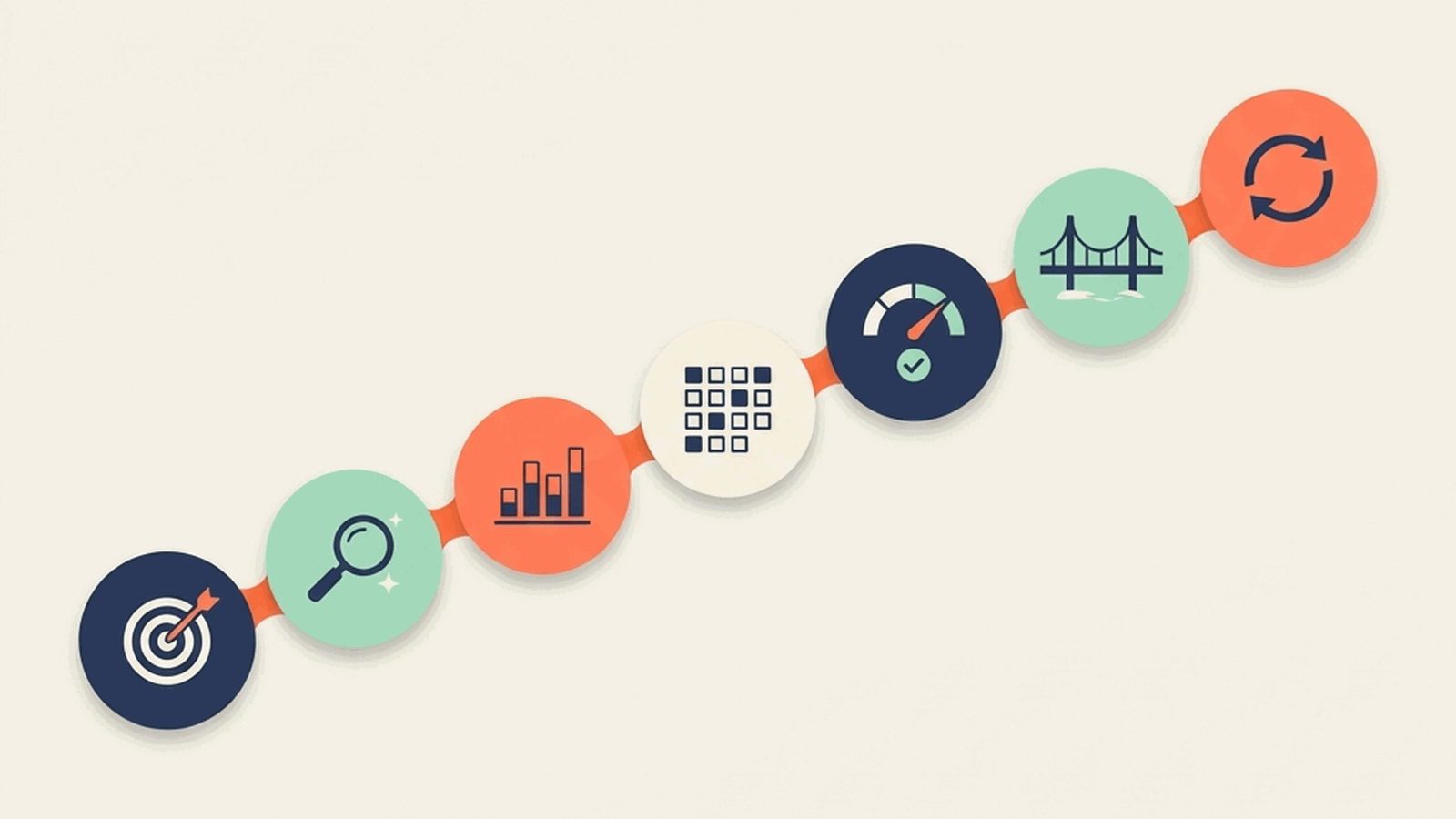
Here is a sequence you can run for any role, from a fresher analyst to a department head. Do it once properly and it pays back across hiring, appraisals, and L&D for years.
Step 1 — Define the role and its outcomes
Start with what success actually looks like. Write down the two or three outcomes a great performer in this role delivers in their first six to twelve months. Everything you map should trace back to these outcomes — if a competency does not help deliver them, it does not belong on the map.
Step 2 — Identify the competencies (KSAB)
For each outcome, ask what knowledge, skills, abilities, and behaviours make it possible. Gather input from top performers, managers, and subject-matter experts — the people who do the job know it best. Aim for 8–12 competencies per role; more than that and the map becomes unusable.
Step 3 — Define proficiency levels
For each competency, describe what it looks like at increasing levels — a simple three-level scale (Basic, Proficient, Expert) works well for most Indian teams. The key is behavioural specificity: “writes clear, structured emails without editing” is usable; “good communication” is not.
Step 4 — Build the competency framework (the matrix)
Lay it all out in a single grid: competencies down the side, proficiency levels across the top, with a behavioural descriptor in each cell. This matrix is your competency map — the artefact you will reuse everywhere. (Use the free template below to start.)
Step 5 — Assess people against the framework
Now measure real people — candidates or existing employees — against the map. This is where a structured competency-based assessment replaces subjective ratings, giving you a consistent, comparable score for each competency rather than a manager’s gut feel.
Step 6 — Map the gaps and plan development
Compare each person’s assessed level against the level the role requires. The gaps are your action list — targeted training, mentoring, or stretch projects for existing staff, and clear hiring criteria for open roles. This is competency mapping turning into ROI.
Step 7 — Review and keep it live
A competency map is a living document, not a one-time project. Roles change, tools change, and expectations rise. Revisit each map at least once a year — and whenever a role’s outcomes shift — so it stays an accurate standard rather than a dusty PDF.
Free competency mapping template
Copy this matrix, replace the sample rows with your role’s competencies, and fill each cell with a specific, observable behaviour. This is the exact structure top HR teams use — start here and adapt.
| Competency | Type | Level 1 — Basic | Level 2 — Proficient | Level 3 — Expert | How to assess |
|---|---|---|---|---|---|
| Workplace communication | Core | Writes understandable messages with guidance | Writes clear, structured emails and updates independently | Adapts tone and structure to any stakeholder; coaches others | Written prompt + SJT |
| Problem-solving | Core | Solves routine problems with a known method | Breaks down ambiguous problems and recommends a path | Frames novel problems others cannot; sets the approach | Case task + cognitive test |
| [Role-specific skill] | Functional | Performs basic tasks with support | Works independently to standard | Handles complex/edge cases; sets best practice | Skills test |
| Data / tool proficiency | Functional | Uses core features | Builds and troubleshoots independently | Automates and optimises; trains others | Practical/skills test |
| Ownership & accountability | Core | Completes assigned tasks | Owns outcomes and flags risks early | Drives outcomes across teams | Behavioural interview + SJT |
| Team leadership | Leadership | Supports team members | Delegates and gives feedback effectively | Develops leaders; aligns the team to strategy | 360 + leadership assessment |
How to use it: keep 8–12 rows, tie every row to a role outcome (Step 1), and standardise the “How to assess” column so two managers would score the same person the same way.
Competency mapping for hiring vs learning & development
The same map serves two jobs. In hiring, it becomes your scorecard — you assess candidates against the required levels and shortlist objectively, exactly the approach a pre-hire assessment platform is built to run. In L&D, it becomes your gap analysis — you assess current employees, compare to the target levels, and fund only the training that closes real gaps.
The mistake is maintaining two different definitions of “good.” When hiring and L&D share one competency map, a person hired against a standard is developed against the same standard — and your whole talent system finally speaks one language. Coursera’s overview of competency mapping makes the same point: the value compounds when the map is used end to end, not in a single silo.
How GroYouth operationalises competency-based assessment

A competency map is only as good as your ability to measure people against it — and that is exactly where most frameworks stall. GroYouth’s GY SAT turns your map into a live, scored assessment: candidates and employees are evaluated against the specific competencies you have defined, and you get a comparable, role-aligned profile instead of a subjective rating.
Run inside the broader Pre-Hire Assessments platform, it means your competency map does real work — in shortlisting, in appraisals, and in building the employable skills your organisation actually needs.
Turn your competency map into measurable hiring decisions — see how GroYouth’s competency-based assessment works.
Frequently asked questions
What is competency mapping?
Competency mapping is the process of identifying and documenting the knowledge, skills, abilities, and behaviours a role requires, then defining what each looks like at different proficiency levels. It turns a vague job description into a measurable standard you can hire, assess, and develop against.
What is the difference between competency mapping and a job description?
A job description lists duties and responsibilities. A competency map goes deeper — it defines the specific capabilities needed to perform those duties well and describes each at increasing levels of proficiency, so it can be used to score candidates and employees objectively rather than just list tasks.
What are the 3 types of competencies?
The three types are core competencies (foundational behaviours expected of everyone, like communication and problem-solving), functional or technical competencies (job-specific skills like SQL or financial modelling), and leadership competencies (people- and strategy-related abilities like coaching and decision-making).
How many competencies should a role have?
Aim for 8 to 12 competencies per role. Fewer than that and the map misses important capabilities; more than that and it becomes too complex to assess or use consistently. Every competency you include should trace directly back to a real role outcome.
How is competency mapping used in hiring?
In hiring, the competency map becomes a scorecard. You define the proficiency level each competency requires, then assess every candidate against the same standard using a competency-based assessment. This makes shortlisting objective, comparable, and defensible instead of dependent on interviewer impressions.
How often should competency maps be updated?
Review each competency map at least once a year, and whenever a role’s outcomes, tools, or expectations change. A competency map is a living document; keeping it current is what ensures it remains an accurate standard for hiring, appraisals, and development.
Turn your competency map into real hiring decisions.
GY SAT scores every candidate and employee against the competencies you’ve defined — objective, comparable, and ready to act on.
Related reads
- The Skills Gap in India
- Employability Skills for Indian Graduates
- How to Create a Skills Assessment
- Upskilling vs Reskilling
- Soft Skills vs Hard Skills
Stop reading 300 CVs
GY AI ATS reads every verified profile and hands you a ranked shortlist in minutes. Hire on proof, not a hunch.
Explore GY AI ATSOn this page
- What is competency mapping?
- Why does competency mapping matter for Indian HR teams in 2026?
- What are the 3 types of competencies?
- Core competencies
- Functional (technical) competencies
- Leadership competencies
- The 7-step competency mapping framework
- Step 1 — Define the role and its outcomes
- Step 2 — Identify the competencies (KSAB)
- Step 3 — Define proficiency levels
- Step 4 — Build the competency framework (the matrix)
- Step 5 — Assess people against the framework
- Step 6 — Map the gaps and plan development
- Step 7 — Review and keep it live
- Free competency mapping template
- Competency mapping for hiring vs learning & development
- How GroYouth operationalises competency-based assessment
- Frequently asked questions
- Related reads
Stop reading 300 CVs
GY AI ATS reads every verified profile and hands you a ranked shortlist in minutes. Hire on proof, not a hunch.
Explore GY AI ATS