Introduction
Have you ever noticed how an Angular interview can begin with simple component questions but quickly shift into deeper discussions about scalability, performance, and architecture?
That is because advanced Angular interviews are not really about syntax alone. They are designed to test whether a candidate can build, optimize, and maintain real-world applications with clarity and confidence. Many candidates are comfortable with Angular basics, but they struggle when interviewers move into deeper areas like unit testing, performance bottlenecks, architectural choices, and technical decision-making.
Recruiters at this level are not just looking for memorized framework terms. They want practical understanding. They want to know whether you can explain why a certain pattern is useful, how you would solve performance issues, and how you would structure an Angular application as it grows.
That is why this guide focuses on advanced angular interview questions around unit testing, performance, and architecture in a clear, interview-focused way. The goal is not just to help you revise Angular concepts, but to help you answer them more effectively in a real interview.
Before diving into the questions, it also helps to know how ready you actually are for your next interview.
Take GroYouth’s free GY-SAT assessment — a 10 mins test with an instant report that helps you understand where you stand.
As part of GroYouth’s AI-powered HR Marketplace, candidates do not just prepare — they improve readiness through:
GY-SAT → Understand job readiness
GY-FIT →simulates real interview scenarios, helping candidates practice under pressure and improve performance—not just knowledge
Marketplace access → Get matched with opportunities
Why Advanced Angular Interviews Go Beyond Components and Templates
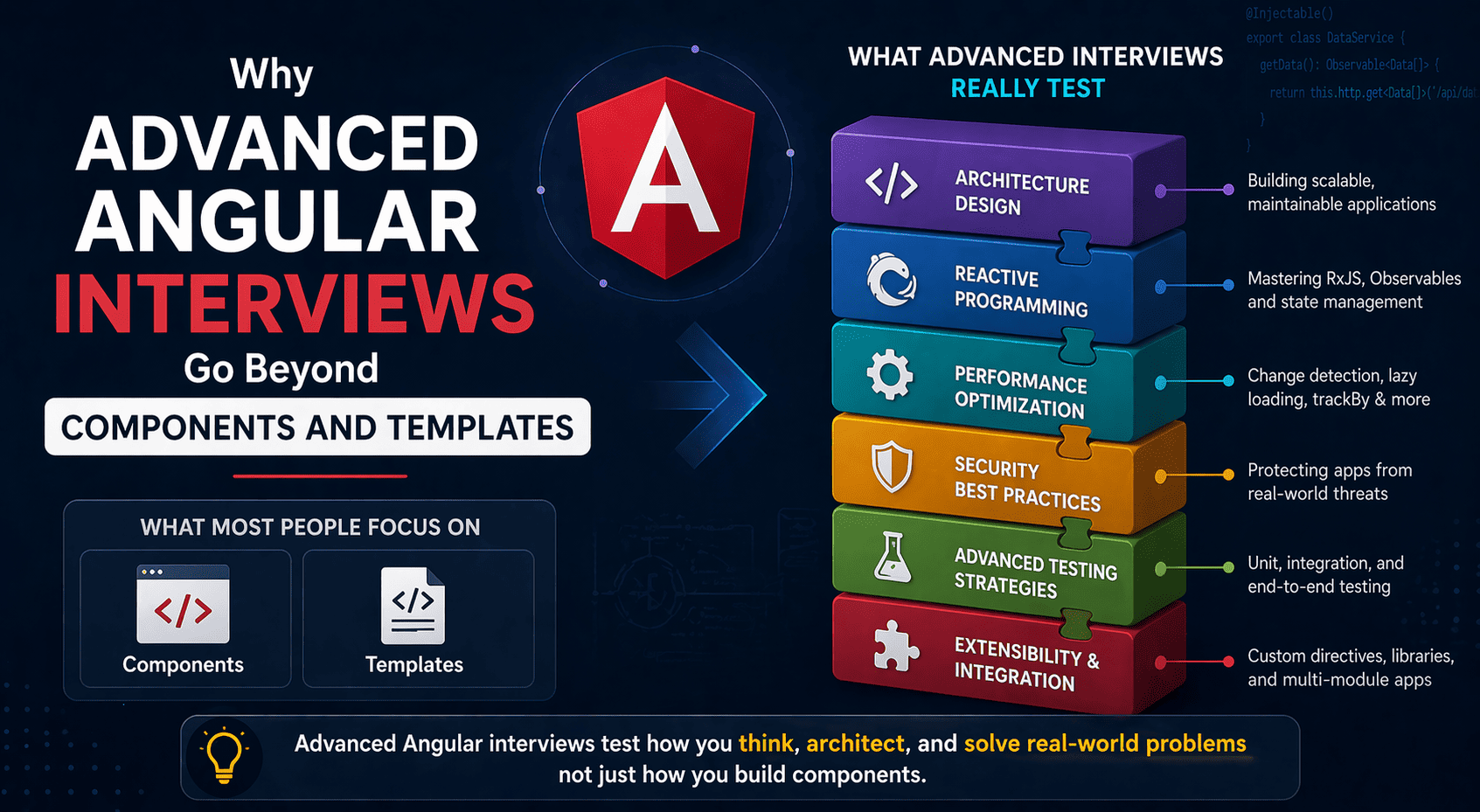
As Angular roles become more advanced, interview expectations also change. At that stage, companies are not only hiring someone who can build UI screens or work with templates. They are looking for someone who can contribute to applications that are maintainable, testable, scalable, and efficient over time.
That is why advanced angular interview questions usually go far beyond components and syntax. Interviewers often test whether a candidate understands performance optimization, testing strategy, architecture decisions, and long-term code quality. They want to know not just what a feature does, but how well the candidate can design it for growth and reliability.
This is also why angular interview questions for experienced often go deeper into trade-offs. Candidates are expected to explain why they would choose a certain pattern, structure, or optimization approach instead of simply naming Angular features. That deeper reasoning is what often separates basic framework knowledge from real engineering maturity.
Here’s another resource you’ll find useful: How to Master the Art of Public Speaking: A Career-Maker’s Guide.
10 Advanced Angular Interview Questions You Should Prepare For
1. How Would You Approach Unit Testing in Angular Applications?
This is one of the most important advanced angular interview questions because it shows whether you understand how to build reliable Angular applications, not just functional ones. A strong answer should begin by explaining that unit testing matters because it helps catch issues early, improves code quality, and makes future changes safer.
You can then mention that Angular unit testing is commonly done using tools like Jasmine and Karma, or modern alternatives, but the real focus should stay on testing mindset rather than naming tools. In Angular, unit tests are often written for components, services, and pipes, depending on what logic needs to be verified.
It also helps to explain the difference between testing logic and testing UI behavior. For example, testing whether a service returns the correct result is different from testing whether a component responds properly to user interaction. That kind of clarity is exactly why this topic comes up often in angular unit testing interview questions.
2. What Is the Difference Between Shallow Testing and Deep Testing in Angular?
This is one of those advanced angular interview questions that checks whether you understand test scope and isolation in a practical way. A clear answer should explain that shallow testing focuses on testing a component in isolation, usually without fully rendering child components or involving too many real dependencies. It is useful when you want fast, focused tests around the component’s own behavior.
Deep testing, on the other hand, includes child components and more of the surrounding dependencies. That gives a more realistic picture of how the component behaves in a fuller environment, but it also makes the test setup more complex and sometimes slower.
The trade-off usually comes down to speed, confidence, and complexity. Shallow tests are easier to manage and quicker to run, while deep tests can provide stronger confidence for integration-like behavior. A strong interview answer should show that both have value, and the right choice depends on what exactly you want to validate.
2. What Is the Difference Between Shallow Testing and Deep Testing in Angular?
This is one of those advanced angular interview questions that checks whether you understand test scope and isolation in a practical way. A clear answer should explain that shallow testing focuses on testing a component in isolation, usually without fully rendering child components or involving too many real dependencies. It is useful when you want fast, focused tests around the component’s own behavior.
Deep testing, on the other hand, includes child components and more of the surrounding dependencies. That gives a more realistic picture of how the component behaves in a fuller environment, but it also makes the test setup more complex and sometimes slower.
The trade-off usually comes down to speed, confidence, and complexity. Shallow tests are easier to manage and quicker to run, while deep tests can provide stronger confidence for integration-like behavior. A strong interview answer should show that both have value, and the right choice depends on what exactly you want to validate.
4. What Are Some Common Ways to Optimize Angular Application Performance?
This is one of the most practical advanced angular interview questions because interviewers want to see whether you can improve performance in real applications, not just talk about Angular features. A strong answer should focus on techniques that reduce unnecessary work and improve how fast the application loads and responds.
Common ways to optimize Angular performance include lazy loading feature modules so the initial bundle stays smaller, using TrackBy in ngFor so Angular does not re-render unchanged items unnecessarily, and applying OnPush change detection where appropriate to reduce extra checks. It also helps to avoid unnecessary re-renders by keeping component design clean and limiting repeated calculations in templates.
Candidates can also mention code splitting, better bundle awareness, and using memoization or caching where it makes sense. These are exactly the kinds of practical areas that come up in angular performance optimization interview questions, because they show whether a candidate understands both performance problems and performance decisions.
5. How Would You Structure a Large Angular Application?
This is one of the most important advanced angular interview questions because it shows whether you can think beyond individual components and build an application that stays manageable as it grows. A strong answer should explain that large Angular applications are usually structured in a way that supports scalability, maintainability, and clear ownership.
A common approach is to organize the app using feature-based modules or folder structures, where each major business area has its own components, services, models, and routing. It is also useful to separate shared modules for reusable UI elements and core modules for app-wide services or singleton logic. This helps avoid duplication and keeps responsibilities clear.
The key idea is separation of concerns. Components should focus on presentation, services should handle business logic or data access, and the overall structure should remain easy to extend. That is why this topic comes up often in angular architecture interview questions, because structure becomes more important as the application and team both grow.
By this point, it becomes clear that advanced Angular interviews are not only about knowing the framework — they are about showing readiness, structure, and decision-making under pressure.
Feeling unsure about your interview readiness?
Take GroYouth’s free GY-SAT assessment — a 10 mins test with an instant report that helps you understand where you stand before your next interview.
As part of GroYouth’s AI-powered HR Marketplace, candidates do not just prepare — they improve readiness through:
GY-SAT to understand job readiness
GY-FIT to practice real interviews
Marketplace access to get matched with opportunities
6. What Role Does Dependency Injection Play in Angular Architecture?
This is one of the more important advanced angular interview questions because dependency injection is closely tied to how Angular applications stay modular and maintainable. In simple terms, dependency injection in Angular means providing required services or objects to a class instead of creating them directly inside that class.
This matters because it improves both modularity and testability. When components and services receive dependencies from Angular rather than building them on their own, the code becomes easier to manage, reuse, and replace. It also becomes easier to test, because mock services can be injected during testing without changing the actual implementation.
A strong answer can briefly mention providers and how Angular handles service injection through its dependency injection system. That is usually enough to show conceptual clarity. This topic appears often in angular dependency injection interview questions because it reflects whether a candidate understands Angular architecture as a system, not just as a UI framework.
7. How Do RxJS and Observables Improve Angular Application Design?
This is one of the more practical advanced angular interview questions because RxJS and Observables are a big part of how Angular handles asynchronous data and event-driven behavior. A clear answer should explain that Observables are commonly used in HTTP calls, forms, and events, which makes them central to real Angular applications.
RxJS matters because it helps manage async flow in a more structured way. Instead of handling everything with scattered callbacks or less flexible patterns, developers can work with streams of data more cleanly. This improves how applications deal with changing values, user input, API responses, and even parts of state handling.
A strong answer should also mention common mistakes, especially unmanaged subscriptions. If subscriptions are not handled properly, they can lead to memory leaks and harder-to-maintain code. That is why this topic comes up often in rxjs interview questions angular — it helps interviewers see whether a candidate understands both the usefulness and the responsibility that comes with reactive programming.
8. How Would You Prevent Memory Leaks in Angular?
This is one of the more mature advanced angular interview questions because it shows whether you think about long-term application health, not just whether the code works right now. Memory leaks in Angular often happen when subscriptions or resources are left active longer than needed, especially in larger applications with many components and async flows.
A strong answer should mention unsubscribing from observables when they are no longer needed, using the async pipe where possible because it handles subscription cleanup automatically, and cleaning up manual subscriptions properly in lifecycle hooks like ngOnDestroy. These are practical habits that help keep the application stable and efficient.
This matters more in large applications because memory leaks can slowly affect performance, increase resource usage, and create hard-to-track issues over time. Interviewers usually like answers that show prevention through good development habits rather than only theoretical awareness.
9. What Is the Purpose of Lazy Loading in Angular, and When Should You Use It?
This is one of the most practical advanced angular interview questions because it connects both performance and application structure. In Angular, lazy loading means loading certain parts of the application only when they are needed instead of loading everything at the start.
The biggest advantage is that it reduces the initial bundle size, which improves the first load performance of the application. This makes the app feel faster, especially in larger projects where loading every feature upfront would slow down the initial experience.
Lazy loading is especially useful for feature modules or routes that users do not need immediately, such as admin panels, reports, or settings sections. A good interview answer should also mention the trade-off: while lazy loading improves initial performance, it needs thoughtful application design so that module boundaries and route structure stay clean. Keeping the explanation simple and tied to real app usage usually makes the answer stronger.
10. How Do You Make Angular Code More Maintainable in Large Teams?
This is one of the broader advanced angular interview questions because it tests whether you can think beyond writing features and focus on how teams build software sustainably. In large teams, maintainability usually depends on consistency, clarity, and disciplined structure.
A strong answer should mention a consistent folder structure, reusable services and components, and clear naming conventions so that the codebase remains easy to understand as more developers contribute to it. It also helps to talk about shared coding standards and testing discipline, because maintainability is not only about writing code once but about making future changes safer and easier.
Another important point is separation of UI, business logic, and data access. When responsibilities are clearly divided, the code becomes easier to scale, debug, and improve. Interviewers usually look for practical team-level thinking here, not abstract theory, so the best answer is one that shows how maintainability supports collaboration as the application grows.
Common Mistakes Candidates Make in Advanced Angular Interviews
Many candidates struggle with advanced angular interview questions not because they lack exposure to Angular, but because their answers do not show enough practical understanding. One common mistake is knowing framework terms well but not being able to explain where or why those concepts should actually be used in a real application.
Another issue is giving overcomplicated answers to practical questions. Interviewers often ask simple-looking questions to evaluate clarity, decision-making, and relevance. Candidates also make mistakes by talking about performance in general terms without examples, ignoring testing strategy completely, or failing to explain architecture decisions in a structured way.
A deeper problem is confusing Angular knowledge with real application design maturity. Knowing components, services, or RxJS syntax is useful, but advanced interviews usually go further. They test whether the candidate can think about maintainability, scalability, performance, and trade-offs in a practical engineering context.
Related read: What is Quiet Quitting? The Real Truth Behind A Concerning Workplace Trend.
How GroYouth Helps Candidates Move From Preparation to Interview Readiness
Preparing for advanced angular interview questions becomes more effective when candidates have a clearer way to measure readiness and improve interview performance. GroYouth helps candidates move beyond passive preparation by giving them a more structured path toward technical confidence and real opportunities.
As an AI-powered HR marketplace, GroYouth supports candidates at multiple stages of the journey. GY-SAT helps candidates understand job readiness through a focused assessment experience. GY-FIT simulates real interview scenarios, helping candidates practice under pressure and improve performance—not just knowledge. Marketplace access then helps candidates move closer to real hiring opportunities instead of staying stuck in preparation mode.
Unlike traditional preparation platforms, GroYouth combines assessment, practice, and real hiring opportunities in one ecosystem. That makes the preparation process feel more connected to actual career movement, not just content consumption.
Conclusion
Doing well in advanced angular interview questions is not about sounding overly technical or repeating framework terms. It is about showing that you can think clearly about testing, performance, architecture, and the trade-offs that come with real application development.
Candidates usually stand out when they explain their decisions in a practical way and show that they understand how Angular applications are built and maintained at scale. That kind of preparation improves not only confidence, but also technical credibility in the interview.
Don’t just prepare — get job-ready.
Take your free GY-SAT assessment now!
GroYouth is an AI-powered HR marketplace connecting job seekers, recruiters, and employers—turning preparation into real opportunities.
FAQs
1. What are the most common advanced angular interview questions?
Common advanced angular interview questions usually cover unit testing, change detection, lazy loading, dependency injection, RxJS, performance optimization, memory leaks, application architecture, and maintainability. Interviewers often ask these topics to see whether a candidate can work on real Angular applications beyond basic components and templates.
2. Are angular unit testing interview questions important for experienced roles?
Yes, angular unit testing interview questions are very important for experienced roles because testing is closely linked to code quality, maintainability, and safe releases. Interviewers want to know whether candidates can test components, services, and application logic in a structured and reliable way.
3. How do I prepare for angular performance optimization interview questions?
To prepare for angular performance optimization interview questions, focus on practical concepts like lazy loading, trackBy in ngFor, OnPush change detection, bundle size awareness, avoiding unnecessary re-renders, and memory leak prevention. It helps to connect these ideas to real project examples instead of only learning definitions.
4. What architecture topics are commonly asked in Angular interviews?
Common Angular architecture topics include feature-based module structure, shared and core modules, dependency injection, separation of concerns, state handling, reusable services, and application scalability. Interviewers often want to know how you would structure a growing Angular application for maintainability and team collaboration.
5. How can I answer advanced Angular interview questions with more confidence?
The best way to answer advanced angular interview questions with more confidence is to practice explaining your decisions clearly. Use project-based examples, focus on why you chose a certain approach, and keep your answers structured around problem, solution, and trade-off. Confidence usually comes from clarity, not from trying to sound overly complex.