Why every HR leader in India is rethinking what a bad hire actually costs
Walk into the office of any HR head at a mid-sized Indian company and ask them what their biggest unsolved problem is in 2026. The answer is almost always the same — they are still making bad hires, the cost is rising, and the tools they have been using for years are not reducing the frequency enough. The real cost of a bad hire has expanded well beyond the salary line in the budget. It now touches productivity, team morale, customer retention, employer brand, and even the cost of the next hire that follows.
This article is a clean, data-backed breakdown for HR leaders in India in 2026. We will walk through what a bad hire is, how its true cost is calculated, what the average impact looks like for Indian organisations, the most common root causes, and the highest-leverage moves leading HR teams are making to bring these costs down. The goal is to give you a reference document you can quote in a budget conversation, a board meeting, or an internal hiring review.
If you are designing your 2026 talent strategy, this is the framing your CFO will respect.
What is a bad hire, and how is the cost of a bad hire calculated?
A bad hire is any employee whose performance, fit, or behaviour falls materially short of what the role required, to the point where the organisation would have been better off hiring someone else. In practice, a bad hire is identified through a combination of missed performance targets, behavioural issues, manager dissatisfaction, peer friction, and ultimately a separation — voluntary or involuntary — within the first twelve to eighteen months of joining.
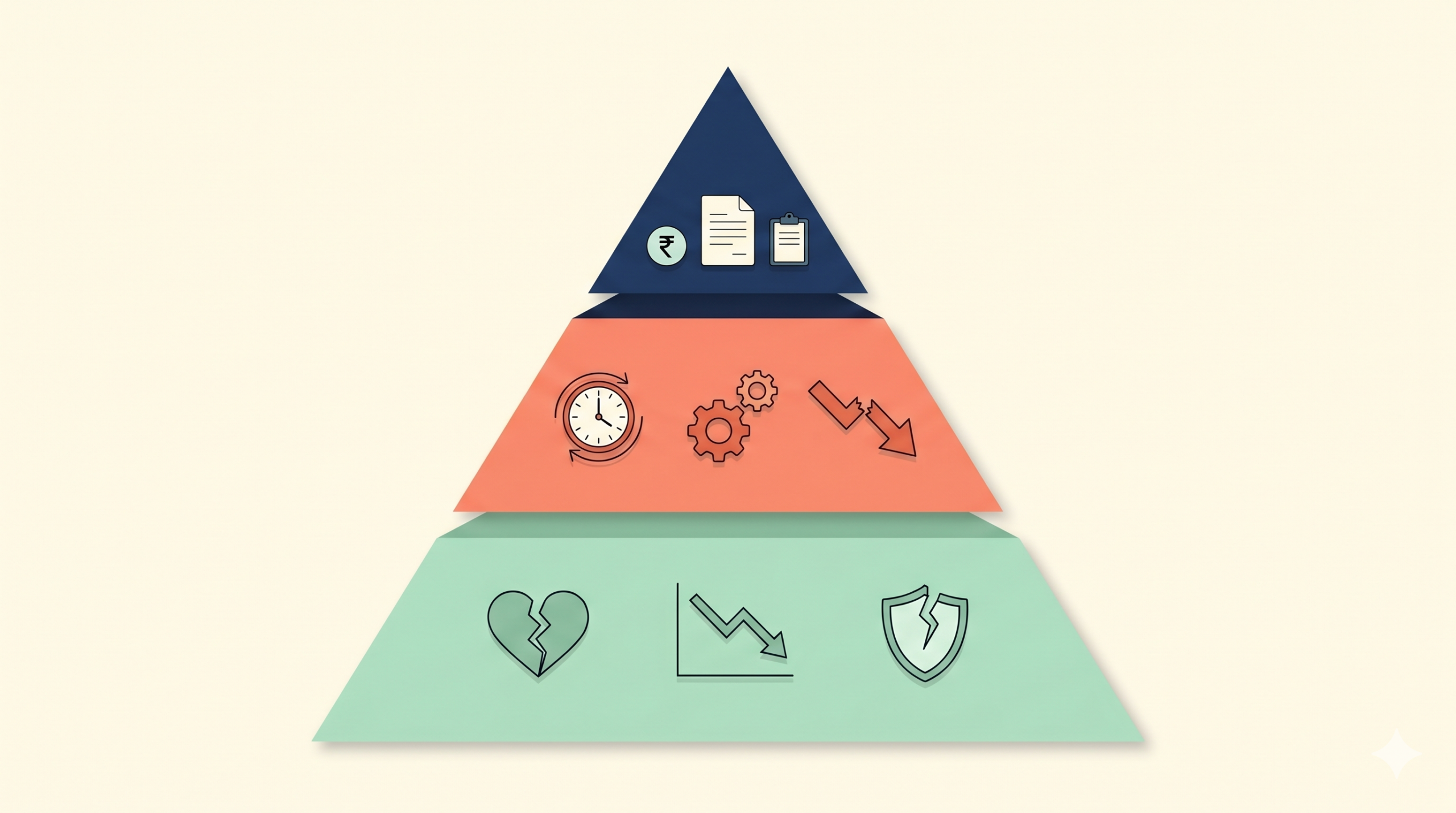
The cost of a bad hire is calculated as the sum of three layers. The first is the direct, recoverable costs that show up cleanly in the finance ledger — sourcing, recruiting, onboarding, training, and the salary paid during the period the person was in the role. The second is the indirect costs that are real but rarely tracked — productivity loss, manager time, peer time spent compensating, project delays, and the cost of the replacement hire that follows. The third is the second-order costs that materialise over time — reduced team morale, customer trust impact, employer brand damage, and the cost of corrective hiring done in a hurry.
Most Indian companies measure only the first layer. The second and third layers usually add up to two to three times the first, which is why finance leaders are often surprised when the full picture is finally laid out for them.
The direct cost of a bad hire
The direct layer is the easiest to calculate because it sits on invoices and salary slips. For an Indian organisation hiring at the early-to-mid career level in 2026, the direct layer typically includes the recruitment fee paid to an agency or platform, the internal recruiter and hiring manager’s time spent on shortlisting and interviews, the onboarding programme cost, the training investment in the first ninety days, the salary paid for the period the employee was in the role before separation, any severance or notice-period buyout, and the administrative cost of offboarding.
For a role at an annual CTC of ten to fifteen lakhs, this layer alone routinely lands between three and six lakh rupees by the time the separation is fully completed. For senior roles at twenty to forty lakhs CTC, the direct layer crosses ten lakhs without difficulty. These are the easiest numbers to defend in a budget review, which is why they are usually the ones that get tracked — even though they are only the visible part of the iceberg.
The indirect cost of a bad hire — what most HR leaders miss

The indirect layer is where the real damage compounds, and it is also where most Indian organisations under-measure. Five categories deserve attention.
The first is productivity loss while the person was in the role. A bad hire is rarely producing zero output, but their productivity is typically half or less of what was expected, and the gap has to be absorbed by teammates or by missed deliverables.
The second is the manager-time cost. Managers spend disproportionate hours coaching, correcting, escalating, and documenting a bad hire. That time is taken from team development, strategic work, and the work of high performers, who often feel the imbalance acutely.
The third is the peer-time cost. Teammates pick up the slack, double-check work, redo deliverables, and absorb client-facing damage. In team-based settings, this can quietly degrade three or four high performers’ output for months.
The fourth is project delays and missed commitments. A bad hire on a critical project can push timelines by weeks or quarters, and the downstream cost of that delay — missed launches, missed revenue, late commitments to customers — often exceeds the entire salary cost of the role.
The fifth is replacement-hire cost. After the separation, the role usually has to be filled again, and the second hire often costs more — a higher recruiter fee, a faster timeline, and a premium offer because the team is now short-staffed.
Add these five categories up, and the indirect layer routinely matches or exceeds the direct layer. Harvard Business Review’s long-running coverage of hiring quality has repeatedly highlighted that the indirect costs of poor hiring are the single most under-measured line in HR economics. (Harvard Business Review)
How much does the cost of a bad hire actually amount to in 2026?
Putting numbers around it is the part HR leaders need most for budget conversations. Multiple independent sources converge on a similar range.
Research from SHRM and other HR bodies has consistently estimated the cost of a bad hire at thirty to fifty percent of the employee’s annual salary on the direct layer alone, with total cost (including indirect impact) often rising to one to two times the annual salary for mid-level roles. (SHRM)
For Indian organisations in 2026, working with these benchmarks and local salary norms, a useful rule of thumb is this. For a mid-level role at twelve lakhs CTC, expect roughly four to six lakhs in direct costs and a further six to ten lakhs in indirect impact, taking the total cost into the ten-to-sixteen lakh range per bad hire. For senior roles at twenty-five lakhs CTC, the total cost can comfortably cross thirty to forty lakhs.
At scale, the number becomes large quickly. An Indian company making one hundred mid-level hires a year, with a fifteen percent bad-hire rate (typical for many Indian organisations), is absorbing fifteen bad hires a year, which translates into one and a half to two crore rupees annually in avoidable cost. For mid-sized firms with three hundred to five hundred hires a year, this number runs into multiple crores, every year, quietly draining the talent budget.
Common root causes behind most bad hires in India
Five recurring patterns drive most of the cost of a bad hire in Indian organisations. They are all addressable.
The first is over-reliance on the interview as the primary screening tool. Most companies still make hiring decisions almost entirely based on a forty-five-minute conversation with a candidate, even though decades of research have shown that unstructured interviews are among the weakest predictors of on-the-job performance.
The second is the absence of structured pre-hire assessment. Without a psychometric or behavioural baseline, the hiring panel has no consistent data on whether the candidate’s reasoning, personality, or behavioural style is a fit for the role and team. This is the single largest preventable cause.
The third is rushed hiring. Indian organisations often hire reactively to fill a gap, with shortened processes and reduced rigour. Speed-to-fill becomes the dominant metric, and quality-of-hire quietly suffers.
The fourth is mismatch between role definition and candidate evaluation. The job description says one thing, the interview tests another, and the actual on-the-job work is a third version. A candidate selected through this loop can be excellent at the interview content and ill-suited for the actual work.
The fifth is weak post-hire integration. Even a strong candidate can become a bad hire if onboarding, manager support, and team integration are poor. The reverse is also true — strong onboarding can rescue marginal candidates.
These five root causes are the result of how Indian hiring has historically worked, but each one is now solvable with better screening, structured interview design, and integrated assessment platforms. For a broader view of the underlying readiness problem feeding this funnel, see our earlier piece on the skills gap in India.
How AI and structured assessment are reducing the cost of a bad hire in 2026
The most measurable shift in Indian HR over the past three years has been the adoption of AI-powered assessment and structured interview platforms before the human interview stage. The logic is straightforward — the earlier a misfit is caught, the lower the downstream cost.
AI-led psychometric and skills assessments give every candidate a consistent, comparable baseline on aptitude, personality, behavioural style, and role fit. Structured AI mock interviews evaluate communication and clarity in a repeatable way, removing the variance that a single human interviewer introduces. Together, they let hiring teams filter for fit before significant time is invested — and that filtering is the highest-leverage way to bring down hiring costs.
This is exactly what GroYouth’s pre-hire assessment platform is built for. The platform cuts the cost of a bad hire by intervening at the earliest point in the funnel — before interview time is spent, before offers are extended, and certainly before the role becomes a separation problem.
How GroYouth helps Indian HR teams reduce hiring mistakes
GroYouth combines five integrated layers built around hiring quality and pre-hire evidence.
GY SAT is the psychometric and skills assessment layer that delivers a consistent, role-aligned readout on every candidate before the interview. GY FIT is the structured AI-led mock interview layer that evaluates communication, clarity, and confidence with the same rubric across every applicant. GY Assist supports candidates with profile and resume readiness, raising the average quality of the applicant pool. GY Portal connects assessed and qualified candidates with verified employers, reducing screening time. And the Recruitment Partner Program extends the same readiness data into external recruiter relationships, so smaller agencies and freelance recruiters can plug into the same evidence base.
For HR teams running campus hiring, GroYouth’s GY Campus placement management platform brings the same pre-hire assessment and structured interview logic into college-to-corporate hiring, dramatically reducing fresh-hire mismatch — which is a major contributor to the cost of a bad hire in IT services, BPO, banking, and other fresher-heavy sectors. For more on the underlying readiness gap feeding this problem, see our piece on the employability skills Indian graduates are missing.
The single biggest lever to bring this cost down is shifting screening upstream, before interview time is invested. The next-biggest lever is making the interview itself structured and AI-supported, so signal quality goes up and inter-interviewer variance goes down.
How recruiters and hiring teams can prevent the next bad hire from creeping in
For recruiters and hiring leaders looking to operationalise this, four moves typically pay for themselves within the first ninety days.
First, introduce a psychometric and skills assessment before the first human interview. This single intervention often prevents the next cost of a bad hire from entering the pipeline.
Second, replace unstructured interviews with structured, behaviourally anchored questions, and use AI-led mock interview tools to ensure every candidate is evaluated on the same dimensions.
Third, document quality-of-hire as a tracked HR metric — not just time-to-fill or cost-per-hire — and review it quarterly. What gets measured gets improved.
Fourth, build a closed feedback loop between hiring managers and the recruitment team after every separation. Every bad hire is a signal about a weakness in the screening process, and capturing that signal is what allows the next hiring cycle to be better than the last.
This is precisely the working model GroYouth helps Indian HR teams adopt — and the platform is built to make every one of these moves measurable.
See how GroYouth’s pre-hire assessment can reduce your bad-hire cost →
Frequently asked questions
What is the cost of a bad hire?
The cost of a bad hire is the total financial and operational impact a company absorbs when an employee’s performance, fit, or behaviour materially falls short of what the role required. It includes direct recoverable costs (recruitment, onboarding, training, salary paid, severance, replacement recruitment fee), indirect costs (productivity loss, manager and peer time, project delays), and second-order costs (team morale, employer brand, customer impact). For Indian organisations in 2026, the total typically lands between one and two times the employee’s annual salary for mid-level roles.
How is bad-hire cost calculated in India?
It is calculated in three layers — direct costs (sourcing, recruiting, training, salary paid, severance, replacement fee), indirect costs (productivity loss, manager time, peer absorption, project delays), and second-order costs (morale impact, customer retention impact, employer brand damage). For a typical mid-level Indian role at twelve lakhs CTC, the total lands in the ten-to-sixteen lakh range per failed hire.
What percentage of new hires turn out to be bad hires in India?
Indian organisations typically see a bad-hire rate between ten and twenty percent of new hires within the first twelve to eighteen months. The rate is higher in volume hiring (IT services freshers, BPO, retail), where it can reach thirty percent, and lower in carefully screened senior hiring. Pre-hire psychometric assessment and structured AI interviews have been shown to bring this rate down materially.
How can companies reduce bad-hire costs?
The highest-leverage interventions are pre-hire psychometric and skills assessment, structured AI-led interviews that remove inter-interviewer variance, behaviourally anchored interview questions tied to actual role requirements, stronger onboarding and manager support, and tracking quality-of-hire as a recurring HR metric. Platforms like GroYouth combine all these layers into one connected workflow.
Is bad-hire cost higher for freshers or for senior hires?
The absolute cost is higher for senior hires because salaries and downstream impact are larger. However, the percentage-of-salary cost can actually be higher for freshers, especially in IT services and BPO sectors, where retraining cycles are long and bad-hire rates are also higher. Both are addressable through pre-hire screening designed for the segment.
What is the difference between cost-per-hire and bad-hire cost?
Cost-per-hire is the total recruitment spend divided by the number of hires — it measures sourcing and selection efficiency. Bad-hire cost is the total downstream financial and operational impact of a hire that fails. The two are related but different — a company can have a low cost-per-hire and still have a very high bad-hire cost if its screening is weak.