The paradox no one warns Indian graduates about
Imagine a final-year engineering student in Pune. She has an 8.7 CGPA, she has done two internships, she has cracked an aptitude test, gone through three interview rounds, and received her first job offer at a well-known IT services company. By every measure that her college and her family use, she is ready.
Three months into the job, she is struggling. Not with the technical work — she can write the code. She is struggling because she does not know how to write a clear email to a senior who is in a different time zone, how to disagree politely in a stand-up call, how to ask for help when she is stuck, how to manage her own time across four parallel deliverables, or how to take feedback on her work without feeling personally attacked. Nothing in fifteen years of formal education prepared her for any of this.
This is the gap. And it is not unique to one student or one company. India’s most respected employability research, the annual India Skills Report and earlier studies from Wheebox and Aspiring Minds, has shown for over a decade that only around half of Indian graduates are considered employable when they enter the workforce. Not because they are not intelligent. Not because they did not study hard. But because the skills that make someone interview-ready are very different from the skills that make someone job-ready, and the Indian education system has historically optimised for the first set and not the second.
This article unpacks what job-ready actually means in 2026, why interview-ready is not the same thing, the eight employability skills most often missing in Indian graduates, and what students, colleges, and recruiters can do to bridge the gap.
What does “job-ready” actually mean?
Job-ready means a person can step into a real workplace and contribute usefully from the first week — not just complete the academic content of the role, but also navigate the working environment around it. It is a combination of three layers: the technical or domain knowledge that the job requires, the workplace behaviours and habits that allow a person to deliver consistently, and the interpersonal skills that allow them to work alongside teammates, clients, and managers.
Interview-ready, on the other hand, means a person can perform well in a structured assessment process — solve a coding question, pitch a project, answer behavioural questions in the STAR format, and complete a psychometric or aptitude test within a time limit. Interview-readiness is a snapshot. Job-readiness is a sustained capability. A graduate can be one without the other.
This distinction matters because companies hire based on interview signals but retain and promote based on job-readiness. The mismatch is what causes high attrition in the first year of employment, especially in IT services, BPO, and entry-level consulting roles, where companies spend the first three to six months essentially completing the workplace education that college left out.
Why interview-ready isn’t the same as job-ready
The Indian academic system has historically rewarded one set of behaviours — sit quietly, memorise content, reproduce it accurately under time pressure, score marks. These are good behaviours for passing exams. They are not behaviours that map to the modern workplace.
Interview-readiness extends those exam-readiness habits one step further. You learn the syntax of common questions, the formats of common assessments, and the scripts of common answers. A student who is interview-ready can walk into a campus placement round and clear it. That is a real achievement. But it does not prove they can hold a conversation with a client, work productively in an asynchronous team, or recover when a project deadline slips and the plan needs to be rebuilt overnight.
The job-ready set of skills is built through doing, not through studying. You build communication skills by communicating in real settings, not by reading a chapter on communication. You build problem-solving by being given ambiguous problems and being allowed to fail and retry. You build ownership by being held accountable for outcomes. Most Indian degree programmes do not provide enough of any of these experiences before graduation, which is why the gap shows up so consistently in the first year of employment.
The 8 employability skills Indian graduates most often lack in 2026
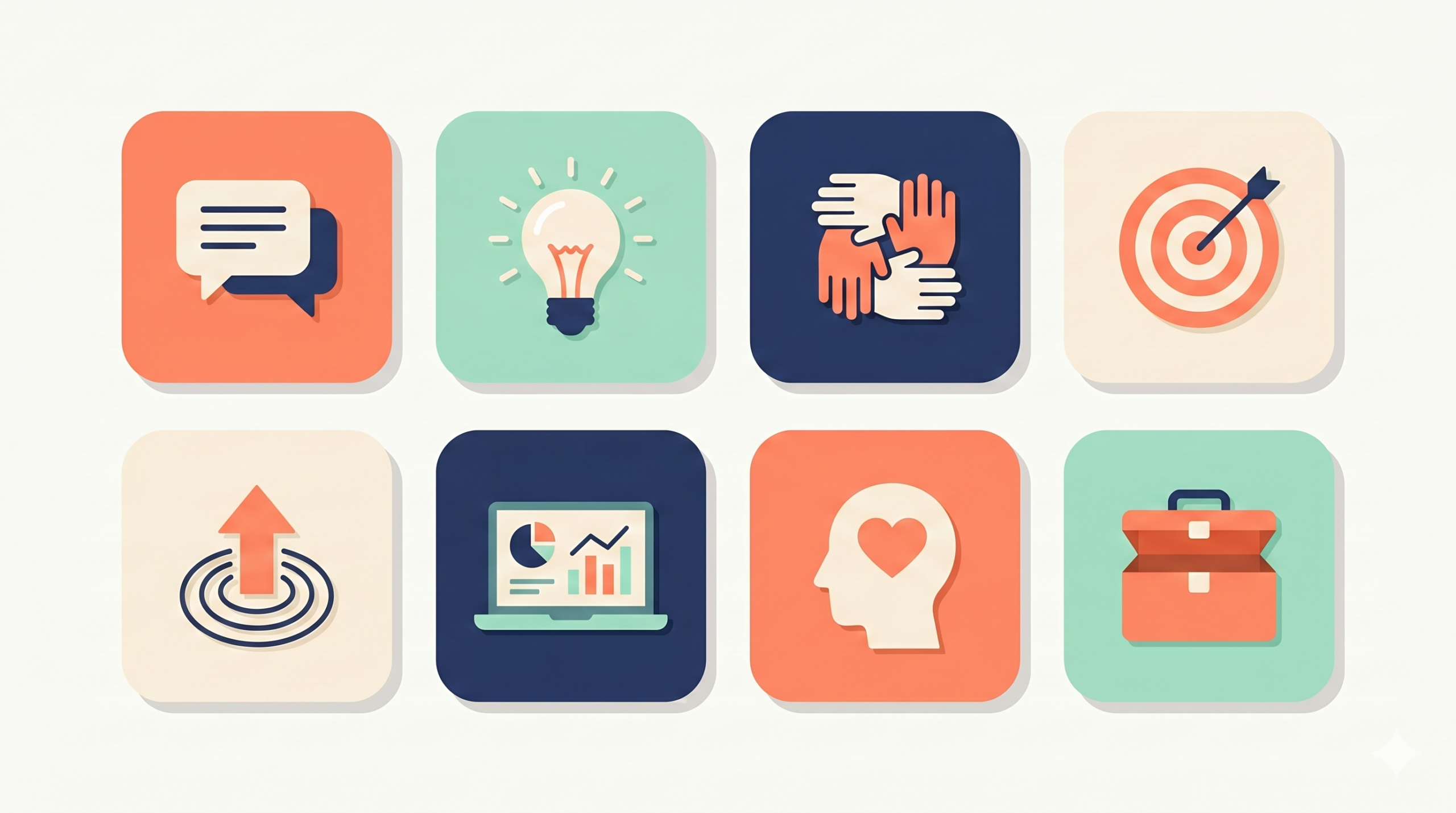
This list is drawn from a decade of employability research from NSDC, NASSCOM, Wheebox, the India Skills Report, and direct feedback from HR leaders across Indian product companies and IT services. The same skills come up year after year, across industries, across degree types, and across tier-1 and tier-3 colleges. The specific weighting changes, but the list does not.
1. Workplace communication
This is the single most cited gap. Not English fluency — though that matters — but the ability to write a clear, structured email, run a meeting with an agenda, present an update in three sentences instead of fifteen, and ask precise questions when something is unclear. Most graduates have spent fifteen years answering questions, not asking them. The shift from receiving information to communicating it to others is harder than it looks.
2. Critical thinking and problem-solving
Indian classrooms reward students for arriving at the correct answer using the method that was taught. Workplaces reward employees for finding a workable answer when there is no method that was taught. Graduates who have only practised the first kind of thinking often freeze when faced with the second.
3. Collaboration and teamwork
Most academic work in India is done individually and graded individually. Group projects, where they exist, are often divided into independent parts that are stapled together at the end. Real workplace teamwork — negotiating ownership, handling disagreement, supporting a teammate who is behind, working asynchronously across locations — requires habits that take real practice to build.
4. Ownership and accountability
In college, the consequence of missing a deadline is a lower grade for one student. In a workplace, the consequence of a missed deadline can cascade across teams and clients. Graduates often underestimate how much of their job is just owning the outcome of their work, including the parts that go wrong, and communicating proactively when there are problems.
5. Adaptability and learnability
The half-life of technical skills is shrinking every year. A graduate hired today for a specific tool stack will almost certainly be using a different stack within three years. The deeper skill — being able to learn new things quickly, comfortably, and without external pressure — matters more than any specific course content. Most colleges still teach a fixed syllabus as if it were durable.
6. Digital fluency beyond their specialisation
A finance graduate who cannot use a spreadsheet beyond basic SUM formulas. A marketing graduate who has never set up a Google Analytics property. An engineering graduate who has never used Git or a project management tool. These are common gaps, and they are not the fault of any single student. The curriculum simply does not require these tools, even though every employer expects them on day one.
7. Emotional intelligence
The ability to read a room, manage your own reactions when you are frustrated, give feedback without making the other person defensive, and absorb feedback without getting hurt — these are not soft, they are operational. They directly affect whether a graduate can build trust with managers and teammates. Colleges almost never teach emotional intelligence formally, and many home environments do not model it consistently either.
8. Domain application
This is the gap that surprises students most. They have studied the subject for three or four years. They have scored well. And then they find that the actual work in the field is quite different from the textbook content. A computer science graduate who can solve algorithm puzzles but has never shipped a feature in a real codebase. A commerce graduate who can pass tax law exams but has never filed an actual GST return. The gap between knowing the subject and applying it is wide, and it is widest at the entry level.
Why this gap exists in the first place
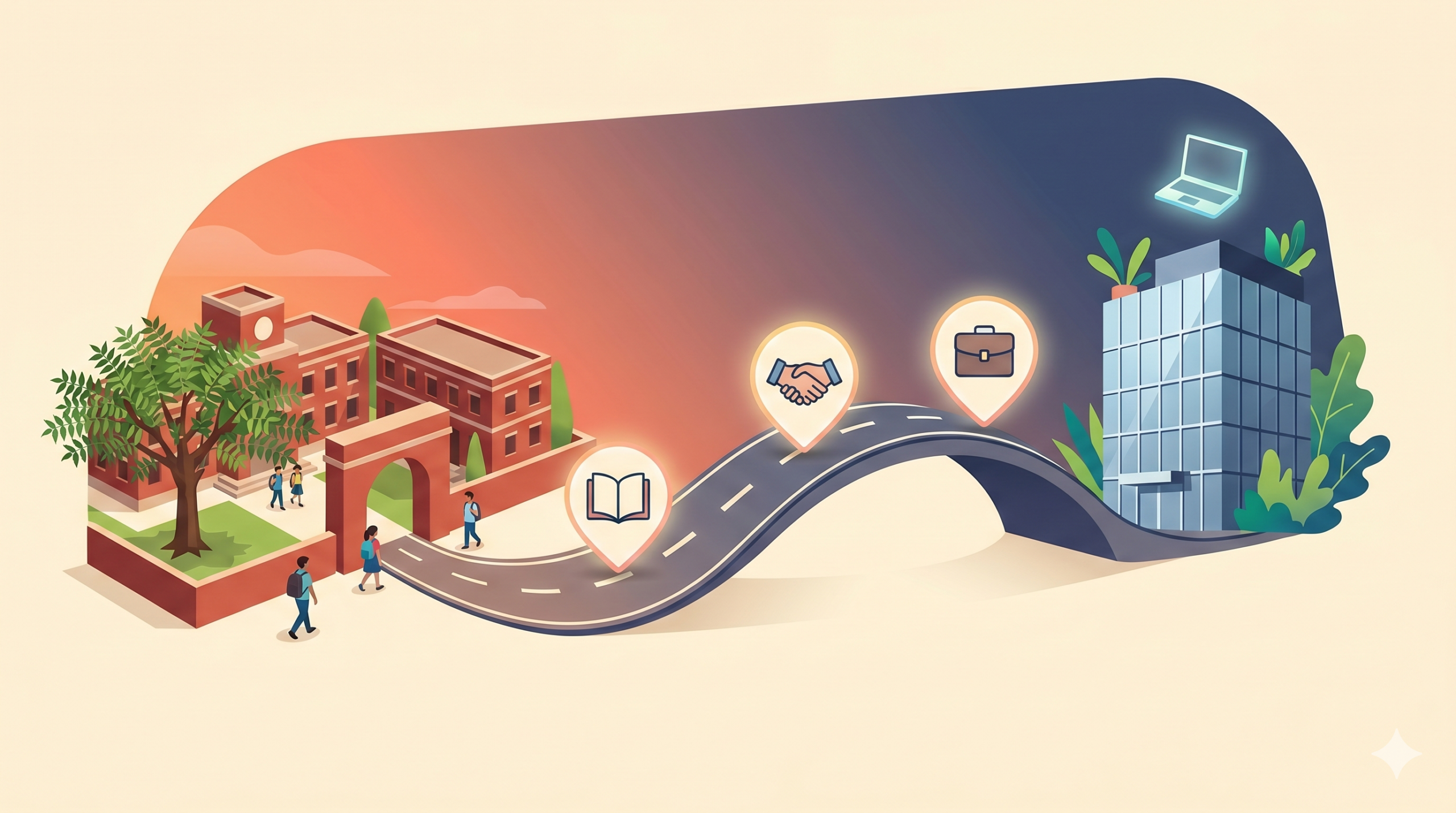
The simple answer is that the Indian education system was not designed to produce job-ready graduates. It was designed to produce certified graduates. Those are not the same goal, and they have not been the same goal at any point in the last fifty years.
Three structural reasons keep the gap in place. First, the assessment model is exam-heavy and rewards memorisation more than application, so students rationally optimise for what is being measured. Second, the curriculum is updated slowly while industry demands change quickly, so even motivated students learn material that is already partially outdated by the time they graduate. Third, the link between colleges and employers is weak in most institutions, so faculty have limited visibility into what skills are actually being looked for, and students have limited exposure to real workplace settings before graduation.
The National Education Policy 2020 has pushed for changes — multidisciplinary learning, internships within degree programmes, vocational training integration, outcome-based assessment. These shifts are real but will take a decade or more to show up in employability outcomes at scale. In the meantime, students and freshers cannot wait. They have to close the gap themselves.
How graduates can build employability skills before they need them
The good news is that every skill on the list above can be built deliberately, outside of college, before the first job. The most effective approach combines three habits over the final two years of a degree.
First, take on small real-world projects in your field. Build a portfolio website. Contribute to an open-source project. Manage social media for a small local business. File your own taxes. The specific project matters less than the experience of finishing something for a real audience. Real audiences provide real feedback, and real feedback is how applied skills get built.
Second, deliberately practise the skills that exam preparation does not build. Join a public speaking club. Write a weekly LinkedIn post. Read business writing guides. Take a free online course in critical thinking or behavioural economics. Find a peer group that gives honest feedback on your work. These are slow-build skills, and they only show up when you put yourself in situations that require them.
Third, get a structured external read on where you stand. Most students do not actually know which employability skills they lack, because they have never been measured on them. A psychometric and skills assessment — like GroYouth’s GY SAT — gives you a clear, comparative read on your aptitude, personality fit, communication, problem-solving, and behavioural strengths and gaps. Once you know where the gaps are specifically, you can build a six-month plan to close the ones that matter most for the roles you want.
What colleges and recruiters can do
For college placement teams, the highest-leverage shift is from “interview preparation” to “job readiness development”. Mock interviews are valuable, but they do not build the skills that retention is measured on. Programmes that integrate assessment, counselling, communication training, project-based learning, and structured mock interviews — like GroYouth’s GY Campus placement management system — give students measurable readiness improvements and give institutions stronger placement outcomes that hold up post-onboarding.
For recruiters and hiring leaders, the shift is from screening for interview performance to screening for job-readiness signals. This includes psychometric and behavioural assessments before interview rounds, structured AI-led mock interviews to measure communication and confidence rather than only content, and richer candidate profiles that show project work and applied skills, not only academic scores. Tools like GY FIT and GY Coach are built for exactly this.
How GroYouth helps bridge the job-ready gap

GroYouth is built around the gap this article describes. The platform takes a candidate through five layers — psychometric and skills assessment with GY SAT, career counselling with GY Coach, AI-powered interview practice with GY FIT, profile and resume optimisation with GY Assist, and verified employer access with GY Portal. Each layer builds one part of the job-ready picture. Together they take a graduate from “I am preparing” to “I am ready”, with measurable signals at every stage.
For students and freshers, the starting point is the GY SAT assessment, which tells you exactly where your employability gaps are. From there, GY Coach and GY FIT help close them, and GY Portal connects you to roles where you are likely to succeed.
For colleges and HR leaders, GY Campus and the broader GroYouth ecosystem bring these readiness layers into one workflow, with analytics that show where each student stands and where intervention is needed before placement season begins.
Take the GY SAT employability assessment →
Frequently asked questions
What are employability skills?
Employability skills are the workplace behaviours, habits, and interpersonal abilities that allow a person to perform well in a job beyond the technical knowledge of the role. They include communication, problem-solving, teamwork, adaptability, emotional intelligence, ownership, digital fluency, and domain application. They are different from academic skills and from interview skills.
Why do Indian graduates struggle with employability?
Indian education has traditionally emphasised exam performance and theoretical knowledge over applied work, group projects, and workplace exposure. As a result, many graduates enter their first jobs strong on technical content but weak on the workplace behaviours that determine whether they succeed in the role. India Skills Reports across the past decade have repeatedly shown employability rates around 45–55%.
What is the difference between job-ready and interview-ready?
Interview-ready means a candidate can perform well in a structured assessment process — interviews, aptitude tests, group discussions, technical rounds. Job-ready means a candidate can step into a real workplace and contribute usefully from the first week. The two require overlapping but distinctly different skill sets, and a candidate can be one without the other.
Can employability skills be learned outside college?
Yes, and increasingly students need to. The most effective approach combines real-world projects, deliberate practice of communication and problem-solving, and structured assessment to identify specific gaps. Online courses, internships, open-source contributions, and platforms like GroYouth that combine assessment with coaching can significantly accelerate the process.
How long does it take to become job-ready?
For an average final-year graduate, building a strong job-ready profile takes between three and nine months of focused effort, depending on the starting baseline and the type of role. A structured plan that begins with a skills assessment and follows a clear sequence (assessment → coaching → practice → projects → mock interviews) is much faster than scattered preparation.
What employability skills do Indian recruiters value the most in 2026?
Workplace communication, problem-solving, adaptability, ownership, and digital fluency consistently rank at the top of recruiter surveys in India in 2026. Technical skill specificity matters by role, but the underlying employability layer is consistent across industries and is increasingly screened for before the technical interview.