Introduction
Many candidates do not struggle in Java interviews because they are weak in coding. They struggle because they cannot explain OOPs concepts clearly when the pressure builds. That is a common problem in technical interviews, especially for freshers.
OOPs concepts are among the most tested topics in Java interviews because they reveal whether a candidate truly understands how Java works. Interviewers are not only looking for memorized definitions. They want to see conceptual clarity, simple explanation, and confidence in applying those concepts to real programming situations. Many candidates know the theory, but they find it difficult to explain it in a way that sounds clear and structured during an interview.
That is why this guide focuses on java interview questions for freshers around OOPs concepts and how to answer them with more confidence. It covers 10 essential questions that interviewers frequently ask and shows how freshers can approach them in a more practical and interview-ready way.
Want to know how job-ready you are before your next interview?
Take GroYouth’s free GY-SAT assessment — a 10 mins test with an instant report to help you understand where you stand.
As part of GroYouth’s AI-powered HR Marketplace, candidates can build readiness through:
GY-SAT → Understand job readiness
GY-FIT → simulates real interview scenarios, helping candidates practice under pressure and improve performance—not just knowledge
Marketplace access → Get matched with opportunities
Why OOPs Questions Matter So Much in Java Interviews
OOPs is the backbone of Java programming, which is why it gets so much attention in interviews. Before moving into advanced topics, interviewers often start with OOPs to check whether a fresher understands the fundamentals clearly.
This is especially true in java interview questions for freshers, where employers want to see whether candidates can apply concepts like inheritance, polymorphism, abstraction, and encapsulation in real coding situations. They are not only testing definitions. They are testing whether the candidate understands how these ideas actually work in Java and how confidently they can explain them.
That is why strong answers matter. In most cases, interviewers respond better to clarity, logic, and simple examples than textbook-style memorization. A fresher who explains OOPs with structure and confidence often creates a much better impression than someone who remembers definitions but cannot apply them properly.
Here’s another resource you’ll find useful: How to Build a Personal Brand That Gets You Hired in 2025.
The 10 Essential OOPs Interview Questions and How to Answer Them
1. What are the main concepts of OOPs?
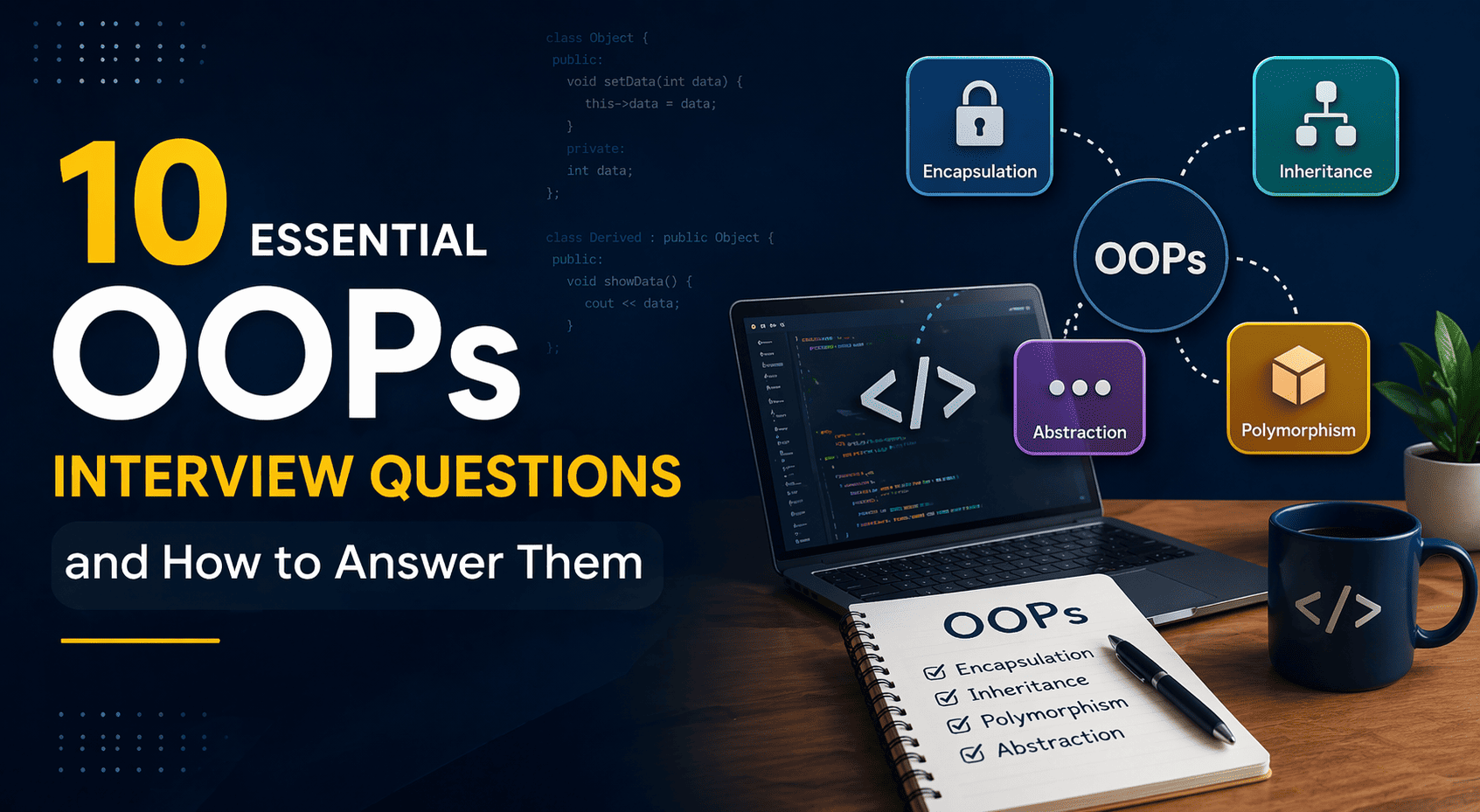
This is one of the most common java interview questions for freshers because it checks whether you understand the foundation of object-oriented programming in Java. A good answer should begin by defining OOPs in simple terms as a programming approach that organizes code around objects and classes.
You can then mention that class and object are the basic building blocks. A class is like a blueprint, and an object is a real instance created from that blueprint. After that, explain the four main pillars briefly: encapsulation, abstraction, inheritance, and polymorphism.
The key here is not to sound like you are reciting a textbook. Interviewers usually prefer a short, clear answer that shows understanding. Freshers should focus on explaining each pillar in one line and keep the response simple, structured, and easy to follow.
2. Explain the Difference Between an Object and a Class
This is one of those java interview questions for freshers that looks simple, but it quickly shows whether your basics are clear. A strong answer should explain that a class is a blueprint or template, while an object is an actual instance created from that class.
A practical example makes the explanation much easier. You can say that Car is a class, but a specific car like my red Honda City is an object. The class defines the properties and behavior, while the object is the real entity that uses them.
It also helps to mention that a class is a logical structure, but an object takes memory when it is created. That small detail shows better conceptual clarity. In interviews, keep the explanation short, practical, and easy to speak aloud instead of sounding overly technical.
3. What Is Inheritance in Java, and Why Is It Used?
Inheritance is one of the core java interview questions for freshers because it tests whether you understand how classes can be connected and reused in Java. A simple answer is that inheritance is a feature where one class acquires the properties and behavior of another class.
You can explain this using the idea of a parent class and a child class. The child class inherits common features from the parent class, which helps reduce repetition in the code. This is why the biggest benefit of inheritance is code reusability.
It is also useful to mention that Java uses the extends keyword to create inheritance. A simple real-world example would be a class called Animal and another class called Dog. The Dog class can inherit common properties and methods from Animal. In interviews, keep the answer practical and relevant instead of turning it into a long theory explanation.
4. What Is Polymorphism? Provide a Simple Example
Polymorphism is another important topic in java interview questions for freshers because it shows whether you understand flexibility in object-oriented programming. In simple terms, polymorphism means many forms. It refers to the ability of the same method or object to behave differently in different situations.
A good answer should briefly mention the two types. Compile-time polymorphism happens through method overloading, where methods have the same name but different parameters. Run-time polymorphism happens through method overriding, where a child class provides its own version of a method already defined in the parent class.
You can also use a simple example to make the answer easier. For instance, the + operator can add numbers, but it can also join strings. That is an easy way to show how the same symbol behaves in different forms. In interviews, clarity matters more than complexity, so freshers should explain polymorphism in a simple and confident way.
5. Differentiate Between Method Overloading and Method Overriding
This is one of the most direct java interview questions for freshers, so the answer should be crisp and easy to compare. The best way is to explain both concepts side by side.
Method Overloading
- Same method name
- Different parameter list
- Usually happens within the same class
- Resolved at compile-time
Method Overriding
- Same method name and same method signature
- Happens in a subclass
- The child class provides its own implementation of the parent class method
- Resolved at run-time
A strong answer should focus on the difference in parameters, class relationship, and execution stage. Interviewers usually ask this to check whether the candidate can compare related concepts clearly without confusion. So instead of giving a long explanation, keep it short, structured, and easy to recall during the interview.
Feeling unsure about your interview readiness?
Take GroYouth’s free GY-SAT assessment — a 10 mins test with an instant report that helps you understand where you stand before your next Java interview.
As part of GroYouth’s AI-powered HR Marketplace, candidates do not just prepare — they improve readiness through:
GY-SAT to understand job readiness
GY-FIT to practice real interviews
Marketplace access to get matched with opportunities
6. What Is Abstraction in OOPs? How Is It Achieved in Java?
Abstraction is one of the most important java interview questions for freshers because it checks whether you understand how Java hides complexity. In simple terms, abstraction means hiding internal implementation details and showing only the necessary functionality to the user.
A good way to explain it is by saying that abstraction focuses on what an object does, not how it does it. For example, when you use a mobile app, you know what action it performs, but you do not see the internal code working behind it.
In Java, abstraction is mainly achieved in two ways: abstract classes and interfaces. Abstract classes can contain both abstract and normal methods, while interfaces are used to define behavior that classes must implement. In interviews, keep the explanation practical and beginner-friendly instead of going too deep into theory.
7. When Should You Use an Abstract Class Versus an Interface?
This is one of those java interview questions for freshers that checks whether you can compare two related concepts in a practical way. A simple answer is that an abstract class is used when classes need some shared implementation, while an interface is used when you want to define a behavior or contract.
An abstract class can have both abstract methods and concrete methods, and it can also contain state through instance variables. That makes it useful when multiple related classes need some common code or shared structure.
An interface, on the other hand, is mainly used to define what a class should do. It is more suitable for capability-based or contract-based design. In interviews, the best approach is to explain this as a simple contrast: use an abstract class for shared implementation, and use an interface when different classes need to follow the same behavior. Keep it practical and avoid turning it into an advanced design discussion.
8. Explain Encapsulation and Its Benefits
Encapsulation is one of the most frequently asked java interview questions for freshers because it shows whether you understand how Java protects and manages data. In simple terms, encapsulation means wrapping data and the methods that work on that data into a single unit, which is a class.
It is usually achieved by making variables private and giving controlled access through public getters and setters. This prevents direct access to the data from outside the class and allows the programmer to manage how values are read or updated.
The main benefits of encapsulation are data hiding, better control, and improved maintainability. For example, if a student’s marks are stored in a class, making the variable private ensures that it cannot be changed directly in an unsafe way. In interviews, a simple example like this makes the concept easier to explain and shows that you understand both the idea and its practical use.
9. What Is the Purpose of the super Keyword in Java?
This is one of the simpler but important java interview questions for freshers because it checks whether your inheritance basics are clear. In Java, super is a reference keyword used to refer to the immediate parent class object.
It is mainly used in three ways. First, it can be used to call the parent class constructor. Second, it can be used to access parent class methods when needed. Third, it can be used to access parent class variables, especially when the child class has variables with the same name.
A simple example would be a child class calling super() to run the parent constructor first. In interviews, keep the explanation direct and example-led. That usually works better than giving a long theoretical definition.
10. Explain the Difference Between Association, Aggregation, and Composition
This is one of the more conceptual java interview questions for freshers, so the answer should stay short, clear, and example-led. All three are relationship concepts in object-oriented programming, but they differ in strength and dependency.
Association is a general relationship where one object is connected to another. It simply means one object uses or is linked with another.
Aggregation is a weak has-a relationship. In this case, one object contains another, but the contained object can still exist independently. A common example is a Department and Students. A department can have students, but students can still exist even if the department is removed.
Composition is a strong part-of relationship. Here, the contained object depends on the container for its existence. A simple example is a House and Rooms. If the house does not exist, the rooms as part of that house also lose their meaning. In interviews, short definitions and strong examples make this answer much easier to deliver confidently.
Common Mistakes Freshers Make While Answering Java OOPs Interview Questions
Many candidates struggle with java interview questions for freshers not because the topic is too difficult, but because their answers do not sound practical or confident in the interview. One common mistake is memorizing definitions without actually understanding what the concepts mean or where they are used. This often makes answers sound mechanical.
Another mistake is giving textbook-style explanations without examples. Interviewers usually remember simple, clear examples more than long theoretical definitions. Freshers also tend to confuse related concepts like method overloading and method overriding, which can weaken confidence during the interview.
Some candidates explain too much theory for very basic questions, which can make the answer feel unfocused. Others know the concept but struggle to speak with enough structure or clarity under pressure. In most cases, strong interview answers are short, logical, example-based, and confidently delivered.
Related read: Upskilling vs Reskilling: Which Career Development Path is Right for You?.
How to Prepare Better for Java OOPs Interviews
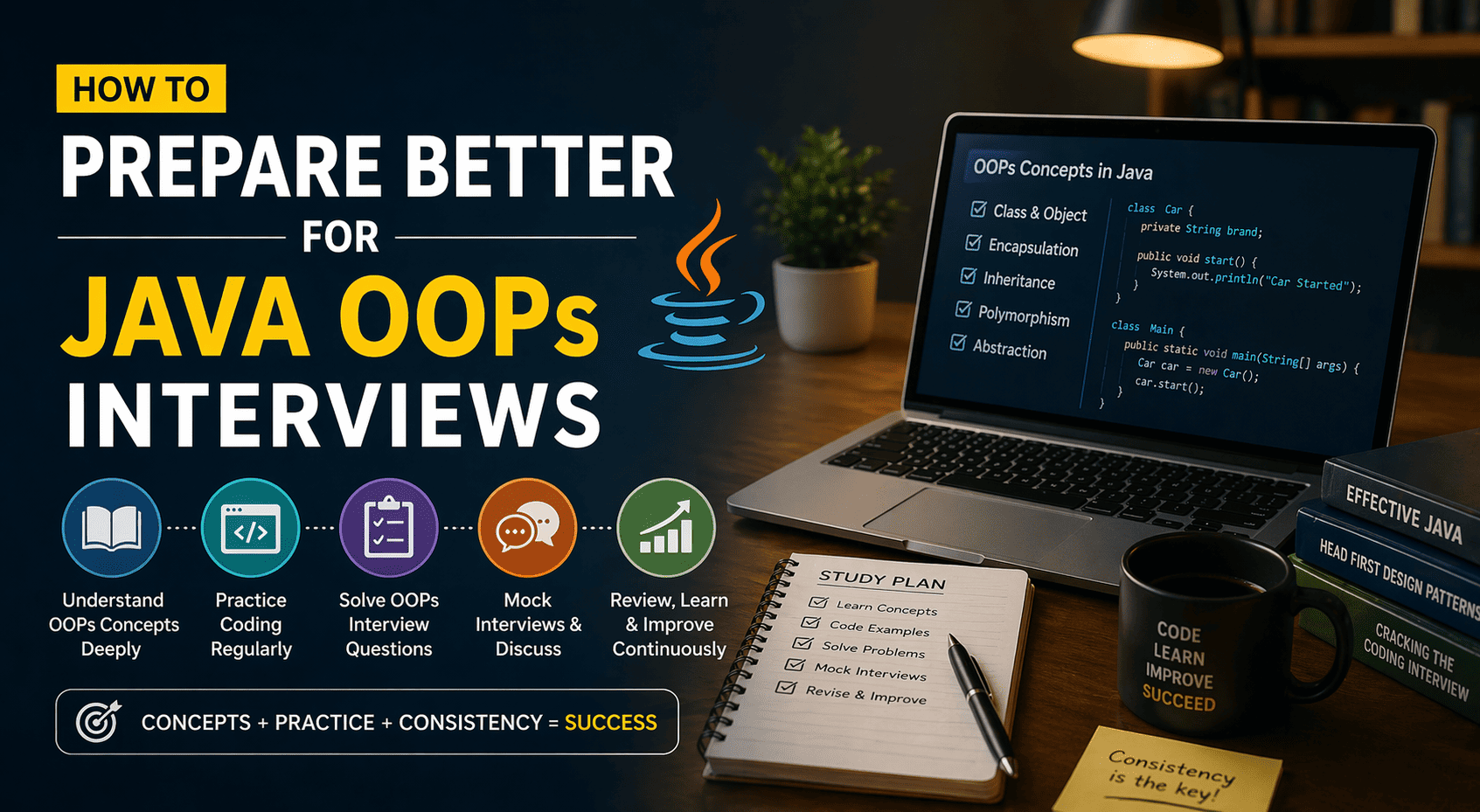
The best way to improve at java interview questions for freshers is to prepare in a practical way instead of only memorizing theory. Start by practicing how to explain each concept in plain English. If you can explain OOPs clearly without sounding overly technical, you are more likely to perform well in the interview.
It also helps to revise core OOPs concepts with simple examples and write small Java programs for each one. That makes ideas like inheritance, abstraction, encapsulation, and polymorphism easier to understand and remember. While preparing for java oops interview questions and answers, focus not just on definitions but on how you would explain them aloud.
Mock interviews and timed speaking practice can also make a big difference. For freshers, the real goal is not to sound advanced. It is to sound clear, structured, and confident with the basics. That often leaves a stronger impression than complicated answers.
How GroYouth Helps Freshers Move From Preparation to Interview Readiness
Preparing for java interview questions for freshers becomes much more effective when candidates have the right structure, practice, and feedback. GroYouth helps freshers build interview readiness with more confidence and a clearer understanding of where they need improvement.
As an AI-powered HR Marketplace, GroYouth supports candidates beyond just learning content. GY-SAT helps freshers understand job readiness and identify strengths and gaps before interviews. GY-FIT helps them practice real interview situations so they can improve communication and confidence under pressure. Marketplace access also helps candidates move closer to real job opportunities instead of preparing in isolation.
This is especially helpful for freshers who may know the concepts but still struggle with readiness, speaking structure, or interview confidence. With the right support, preparation becomes more practical and more purposeful.
Conclusion
Strong preparation for java interview questions for freshers is not about memorizing definitions and repeating textbook answers. It is about understanding the concepts clearly and being able to explain them with simple logic and practical examples. That is what usually helps candidates stand out in interviews.
When freshers can explain OOPs concepts with clarity, structure, and confidence, they create a much stronger impression than those who only remember theory. Consistent practice, simple coding examples, and better speaking preparation can improve both confidence and interview performance over time.
Don’t just prepare — get job-ready.
Start your free assessment now.
GroYouth is an AI-powered HR marketplace connecting job seekers, recruiters, and employers—turning preparation into real opportunities.
FAQs
1. What are the most common java interview questions for freshers on OOPs?
Some of the most common java interview questions for freshers on OOPs include class and object, inheritance, polymorphism, abstraction, encapsulation, method overloading, method overriding, abstract class versus interface, and the use of the super keyword. Interviewers often ask these to test conceptual clarity and basic Java understanding.
2. How do I explain OOPs concepts clearly in a Java interview?
The best way to explain OOPs concepts clearly is to use simple language and small examples. Instead of giving long textbook definitions, focus on what the concept means, why it is used, and where it applies in Java. Clear structure usually makes the answer stronger.
3. What is the difference between inheritance and polymorphism in Java?
Inheritance means one class acquires the properties and behavior of another class, mainly for code reusability. Polymorphism means the same method or object can behave in different ways. In simple terms, inheritance builds relationships between classes, while polymorphism gives flexibility in behavior.
4. Are java oops interview questions and answers enough for freshers to prepare?
Reading java oops interview questions and answers is useful, but it is usually not enough by itself. Freshers should also practice speaking their answers aloud, write simple Java programs, and use examples so they can explain concepts confidently in real interviews.
5. How can freshers improve confidence before a Java technical interview?
Freshers can improve confidence by revising OOPs concepts well, practicing common questions, doing mock interviews, and explaining answers in plain English. The more you practice with examples and structure, the more natural and confident your answers will sound.